I got my first taste of European Christmas markets chaperoning a school trip to Vienna. Having always has a soft spot for street food and markets, which I think are one of the most authentic ways to experience a city, I immediately fell in love with the magic of Christmas markets.
I was worried about being sad and lonely during the month of December being away from home during the holiday season, so I decided to distract myself by seeing as many different Christmas markets as possible. I was a women on a mission; I ended up seeing seven different Christmas markets in central Europe during the month of December. Here are my top three favorite Christmas markets, two recommendations on what to eat and drink, and one tip on how to stay warm.
Vienna, Austria
The Viennese Christmas market was something out of a dream, a true winter wonderland. Situated in Rathausplatz under the beauty of Rathaus (City Hall), the market is made up of three parts: The Christkindlemarkt, The Little Ice Dream, and the Christmas World. The Christkindlmarket is a traditional Christmas market with 154 stalls consisting of food, beautiful ornaments, and traditional Christmas decorations. I recommend the Bratwarst and pumpkin soup, though I don’t think you can go wrong with any food choice. There also was an amazing Kinderpunsch. It’s easy to get lost in the maze of stalls surrounded by the aromas of lebkuchen (gingerbread) and cinnamon, delicious chestnuts and punsch, and be transported to a Christmas paradise.
Not only is the Christkindlemarkt top notch, but the addition of The Little Ice Dream (ice skating) and The Christmas World (mini amusement park) take this Christmas market to the next level. Don’t be fooled by the name The Little Ice Dream, this is no ordinary ice rink and it is definitely not small. This ice rink is a maze with many different path ways to skate around. It is such a unique experience and so much more entertaining than just skating in circles in a normal rink. It is called “Little” because after the Christmas market closes the ice skating will double in size and take over the spot the market was in, this becomes known as Vienna Ice World. It is also pretty affordable, a ticket is good for the entire day and costs 7.50 euro per adult (including a 2 euro deposit), and there are family and children discounts. Rentals cost 7 euro per adult and a locker costs 2.50 euro which was able to fit three pairs of shoes and a purse. At the Christmas World a historic roundabout, a reindeer train, a Ferris wheel and much more await for children to explore.
This Viennese Christmas Market at Rathaus alone would be enough for Vienna to secure the top spot, this market is only one of a dozen different markets throughout the city. Just strolling through the city you are bound to stumble across a couple different markets each with their own character. Two other markets I recommend checking out in Vienna is the Christmas Village Maria-Thereesien Platz and Christmas and New Year’s market at Schönbrunn Palace. Experience impressive Viennese buildings and traditional customs at the Christmas Village Maria-Theresien Platz, located between the Museum of Natural History and the Museum of Art. There is no escaping the Christmas atmosphere with festively decorated market stalls and a vast array of culinary delights. Right in front of the famous Schönbrunn Palace, approximately 60 exhibitors present handicrafts and original gifts such as handmade Christmas decorations and nativity sets for visitors to admire and purchase.


Dresden, Germany
Dresden Striezelmarkt is the oldest Christmas market in Germany and potentially in all of Europe dating back to 1434. This market was the most charming and had the most character out of all the market I went to and has over 250 stalls. The focal point of the market is the world’s tallest Christmas pyramid, with a height of 14 meters. There were amazing handmade crafts and beautiful Christmas villages. The hand painted ornaments were beautiful and incredibly affordable. I would recommend Dresden as the best place to buy Christmas ornaments. The food was incredible, so I encourage going with a group of people so you can try and share a bunch of different foods. The markets name is actually derived from its most famous food the Dresden Christstollen, a Christmas cake. This market was very child friends with puppet shows, cookie decorating activities, a Ferris wheel and carousel, and most importantly amazing Kinderpunsch (see Kinderpunsch, Mugs, and More below).


Pilsen, Czech Republic
Skip the Christmas market in Prague which is very touristy, repetitive, and lacks charm and take an hour and a half bus to Pilsen (the home of Pilsner Urquell) for a more unique and traditional experience. The market takes place in the giant city center of Pilsen right by the beautiful St. Bartholomew Cathedral. For a small fee of 50Kc a person you can even climb to the top of the cathedral and get an incredible aerial view of the market. For hot alcoholic beverages make sure to try Medovina (mead), a honey-based drink, and Svařák (mulled wine), a red wine with a hint of cinnamon and cloves. Unfortunately, there is no Kinderpunsch equivalent at Czech Christmas markets. Finally, make sure to try Trdelník, a spiraled dough in a chimney shape covered in a sugar walnut mix. In the Czech Republic, Trdelník use to be known as the poor man’s desert because of its simplicity of ingredients and cooking. Today, you can find Trdelník everywhere in Prague, but outside of its traditional form catering to tourists. In many tourist places in Prague it is not cooked over hot coal and Nutella or ice cream is put in side. The best Trdelník in my opinion is in its traditional form plan and cooked over coal, while you can find this in Prague the best place to find it is outside of the Prague. Trdelník has been around Europe for centuries dating back as far as ancient Greece under a variety of names.


Kinderpunsch, Mugs, and More
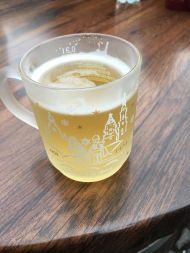
Hot alcoholic beverages are a staple of Christmas markets in Europe. In Germany and Austria there were many different flavored punsch to choose from, ranging from mulled wine (Glühwein) to a combination of tea, spices, sugar, and spirits (mainly rum and brandy). In the Czech Republic, the most common drinks are Medovina (mead) and Svařák (mulled wine) (see Pilsen, Czech Republic above). In Germany and Austria they give you your drink in a nice mug, because of the mug don’t be surprised if you order a 3 euro drink and pay 7 euro. The additional 4 euro is a deposit for the mug, you can either keep the mug or return it and get your 4 euro back. You can return it to any stall within the market because each stall within one market uses the same mugs. Be careful though because sometimes there are two markets right next to each other that are hard to differentiate but they have different mugs. The mugs tend to be very beautiful and there is a new mug for each market every year so many people keep the mug as a collectable. Since I do not really drink I skipped the alcoholic beverages and became obsessed with what is known as Kinderpunsch (children’s punch). Every Christmas market in Germany and Austria has their own Kinderpunsch which is nonalcoholic and made for children (I received a handful of judgmental looks when I order it for myself lol). It usually is some version of hot apple cider. I drank gallons of Kinderpunsch during the month of December.
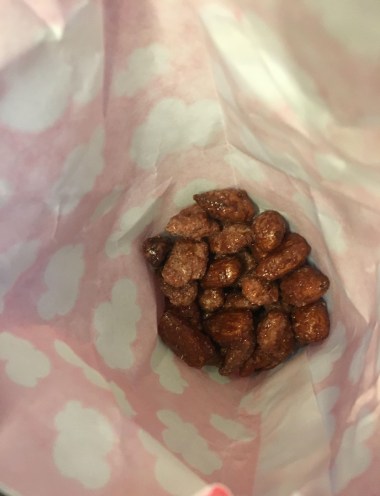
Gebrannte Mandeln (German Candied Almonds)
These candied almonds were sold at every Christmas market I went and were my favorite food. While dozens of different flavors were sold I always stuck to the tradition cinnamon sugar one. I would buy a large bag and keep it in my purse as a snack for the train ride home.
How to Dress Warm
During my first Christmas market in Vienna, I was freezing the entire time. Though wearing what I would normally wear outside during the winter I was dressed warm enough to spend hours outside in the cold. I realized that in the US I never hangout outside during the winter; I am just walking directly from one place to the next or jumping in and out of cars. I recommend dressing like you were going to a football game in the winter. Below is what I recommend to dress warm and keep up with European fashion:
- Two pairs of pants: I usually wear thermals or leggings underneath a pair of jeans. I purposely bought a pair of jeans that were one size too big to keep fit an extra pair of pants underneath.
- Warm sweater
- Vest: I wear either a down vest or a Better Sweater vest from Patagonia.
- Winter jacket
- Wool socks
- Boots with wool or fleece lining
- Gloves
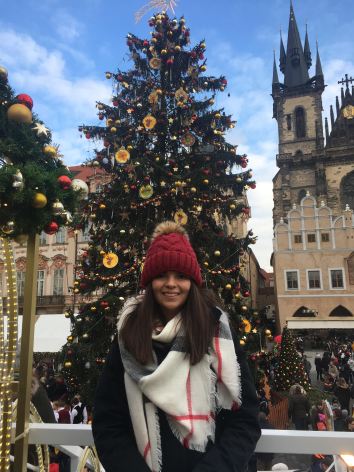
- Blanket scarf: On the Vienna trip all of my students had these giant scarfs and I spent the whole day envious of how warm they must be in their scarfs and I knew I needed one. The ones I bought are a giant square that you fold in half to a triangle. You put the bottom of the triangle in front of you and wrap the other two sides of the triangle around your neck and pull them down on the opposite side. Blanket scarfs are not only warm and fashionable but also are multiuse. I used them as a blanket or to cover my eyes for sleeping on trains or in hostels.
- Hat: Make sure you had a warm hat, all of the hats I brought with me weren’t warm enough. I bought a double lay (fleece and knit) hat that is incredible warm. It also has a fur ball on top, which is very fashionable in Europe. Unfortunately, I did not realize when I bought it that it was actually real rabbit fur, so make sure to check for that before you buy anything.

 In Pursuit of the Traveler